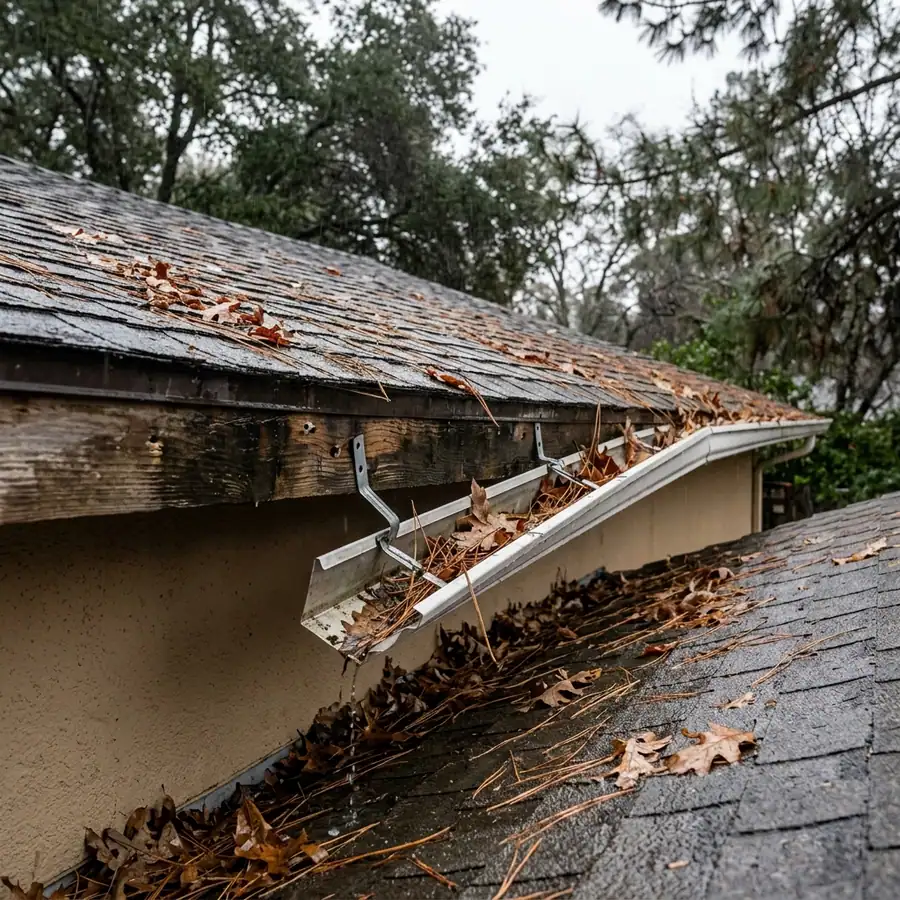
Clogged Gutters
Clogged gutters are behind most other gutter problems homeowners eventually deal with. Once debris blocks the trough, water has nowhere to go, so it either overflows the edge or sits trapped against the metal and hangers.
Valley oak leaves and acorns dominate fall and winter debris across most of the region, with pine needles and windblown sediment adding to the load in specific neighborhoods. Fall leaf drop happens right before rainy season starts, creating the exact combination that causes the worst overflow events each year.
- Water spilling over the gutter edge during rain
- Visible debris piled above the gutter line
- Plant growth sprouting from trapped organic material
The fix: Regular cleaning, timed before peak leaf drop in October and November, clears the problem before it causes secondary damage. See our full gutter cleaning cost guide for pricing by home size.
Sagging Gutters
A sagging section usually means the hangers holding that part of the gutter have failed or were never spaced closely enough to begin with.
Cheap or widely spaced hangers, often installed every 36 inches instead of the sturdier 24 inch spacing, cannot handle the combined weight of debris and water once a Sacramento storm hits. Summer heat adds to the problem, since expansion and contraction at the mounting points gradually loosens hardware year after year.
- A visible dip or bow in one section of the gutter run
- Water pooling in the low point instead of draining
- Gaps forming between the gutter and fascia
The fix: One sagging section is typically a hanger issue, fixable with re-securing and re-pitching. Three or more sagging sections across the run usually point to rotting fascia boards behind the gutter, which changes the fix from a simple repair to a bigger job. See our full gutter repair guide for detailed pricing by repair type.